
'Rather than an outcome of 'pro-incumbency', the exit poll results betray a completely lackadaisical approach of the Opposition parties.' 'While a new kind of politics was on display for the past five years, they were still mired in their old-style methods which will cost them the election,' predicts Utkarsh Mishra.

Single window clearances for realty must.

At least 36 people were injured on Friday when a blast hit an anti-government protest march in Bangkok demanding the ouster of Thai premier Yingluck Shinawatra, raising fears of violence in the run up to the February 2 snap polls.

Did you know there are laws made as far back as 1836 still in circulation in the Indian legal apparatus?
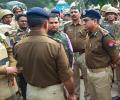
Of the 27 named, at least four are workers and functionaries of right-wing organisations, including the Bajrang Dal, officials said.

Kerala Chief Minister Oommen Chandy tells rediff.com's Shobha Warrier why the UPA lost in the general elections, the decline of the Left and what he expects from the Centre.

Chief Economic Advisor Arvind Subramanian's interview.

'Unless we change and we see a change in the direction we are taking, times can only get worse.'
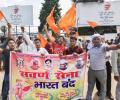
'The BJP has lost 5 states and Lok Sabha elections are due in less than 90 days.' 'The reservation bill is a jhunjhuna (lollipop) for the upper castes.'

We can hope that some of the benefits of the rural spending - on irrigation, roads, etc -- will spur rural demand and improve rural productivity, says P V Subramanyam.
We can hope that some of the benefits of the rural spending - on irrigation, roads, etc -- will spur rural demand and improve rural productivity, says P V Subramanyam.
We can hope that some of the benefits of the rural spending - on irrigation, roads, etc -- will spur rural demand and improve rural productivity, says P V Subramanyam.

Instead of a consumption stimulus the government must address the NPA issue with a war footing and invest in infrastructure, affordable housing and exports, says Sanjeev Nayyar.

Kejriwal sought to remind AAP volunteers, MLAs and Delhi government ministers that things will get worse in the coming days and exhorted them to 'leave' if they are not strong enough.

'How many people have been skilled up and thus able to escape from needing to be in NREGA? The true success of NREGA would lie in its irrelevance -- that is, people no longer need it as a crutch.' 'NREGA should enable them to climb out of poverty and stand on their feet.' 'But this is expressly forbidden by NREGA rules. Skill development, which is what India needs more than anything else, appears to be outside the purview of NREGA,' points out Rajeev Srinivasan.

Rate sensitive sectors rallied the most led by banks while metals surged on rebound in commodity prices

Opposition parties ask the government to listen to the concern of the intellectuals returning awards.
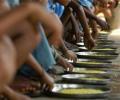
While the Delhi and Haryana governments have declared that they are all set to roll-out the food security programme on August 20 -- Rajiv Gandhi's birth anniversary -- there is confusion among the chief ministers about the implementation of the ordinance which gives the right to people to receive adequate quantity of food grains at affordable prices. Anita Katyal reports.

'I am just another Harayanavi girl. If I can do it, other girls can do it too,' says the naval officer who led the Indian Navy's marching contingent on Republic Day.

Pranjul Bhandari, Chief India Economist, HSBC, speaks about a range of issues ranging from inflation, to how Goods and Services Tax and land acquisition bills can help India hit double digit growth, and her impressions about economic growth in the last one year after Narendra Modi took over as India's Prime Minister.
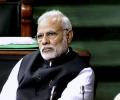
Demonetisation hit informal sector hard and caused job losses which was not addressed by the budget, Moily said.
.jpg)
We present Prime Minister Manmohan Singh's full speech as he addressed the country on the occasion of 66th Independence Day, from Red Fort, Delhi.
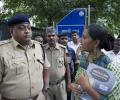
It is regrettable that the IB has tried to devalue the expertise available both within the concerned ministry and in the scientific community by its allegations. Governments and NGOs in many western nations have not been accused of being 'anti-national' when they put their foot down on questionable practices by cash rich agri-business companies, says Rashme Sehgal.

US congressional leaders on trade and finance wrote to the US International Trade Commission calling for a second investigation into India's 'unfair' trade practices, detailing any changes under Modi.
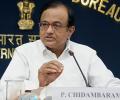
'The Congress can't return to power unless it reins in prices, lowers interest rates, taxes the rich,' says Praful Bidwai. 'If this means sacking those most responsible for the UPA's pro-big business policies including Finance Minister Chidambaram, so be it!'
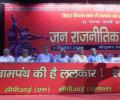
The Left parties said they have come together to provide an option to the public to provide "people's rule" in the true sense.

'This has to be seen in the context not only of the legacy we inherited, but also of global economic weakness.'
'If after inheriting the very bad situation we have reached this level despite consecutive years of drought and no growth in the world economy, it is no accident.' 'It is a result of the sound macro economic policies followed by this government.' 'We have eschewed populism and stuck to a path of fiscal prudence.'

There are conflicting signs on India's investment cycle.

Younger party leaders are livid with the Murli Manohar Joshi-headed manifesto drafting committee for not taking their suggestions, reports Archis Mohan.

Now, the world over, policymakers are dusting off their copies of Keynes' classic, The General Theory of Employment, Interest and Money, and figuring out whether there are any answers there to our own challenges of growing our economies.

Since 2000, India has had three serious droughts.
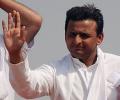
Notwithstanding reluctance of some leaders of regional parties to make it public, UP Chief Minister Akhilesh Yadav is strongly in favour of a Third Front to prevent communal forces from coming to power after the Lok Sabha elections

Implementing the Food Ordinance is the bigger challenge and there are many provisions of the National Food Security Bill which need to be expanded and strengthened.

'If Modi arrived like a juggernaut, he left like a jigsaw puzzle whose pieces were being dismantled bit by bit. It was as if India had seceded quietly from him.' Shiv Viswanathan's social science fiction about what India would be like in 2020.
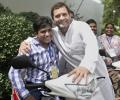
'Manmohan Singh was blamed for administrative paralysis, but if you speak to any senior bureaucrat today, they are very bitter and say that files do not move. I am told that more than a thousand files are awaiting clearance.'
M R Venkatesh, chartered accountant turned political commentator tells Shobha Warrier/Rediff.com that Modi's war is not against the opposition parties or the Congress but against the bureaucracy and the establishment.

As India gears up to honour its pravasis on January 9 to mark their contribution in the nation's development, rediff.com presents perspectives from eminent writers on the Diaspora. Kicking off the series is Ambassador T P Sreenivasan, who points out that the change of the Diaspora policy put in place by Rajiv Gandhi following the military coup in Fiji and his decision to stand by them, was the one defining moment in India's dealings with its overseas family.

'India's economy is growing faster compared to the developed economies of the world.' 'More importantly, it is growing faster compared to most of the developing economies.' 'The monsoon is not the only thing that drives the rural economy and certainly not the national economy.' 'It is too simplistic to reduce everything to the monsoon.'
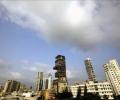
The underlying tone of a call for separate Mumbai city is always seen as a class war and a linguistic war, says Neeta Kolhatkar

Nitin Gadkari has seven portfolios, but does not seem weighed down at all by the many things on his plate. The minister is brimming with ideas...
